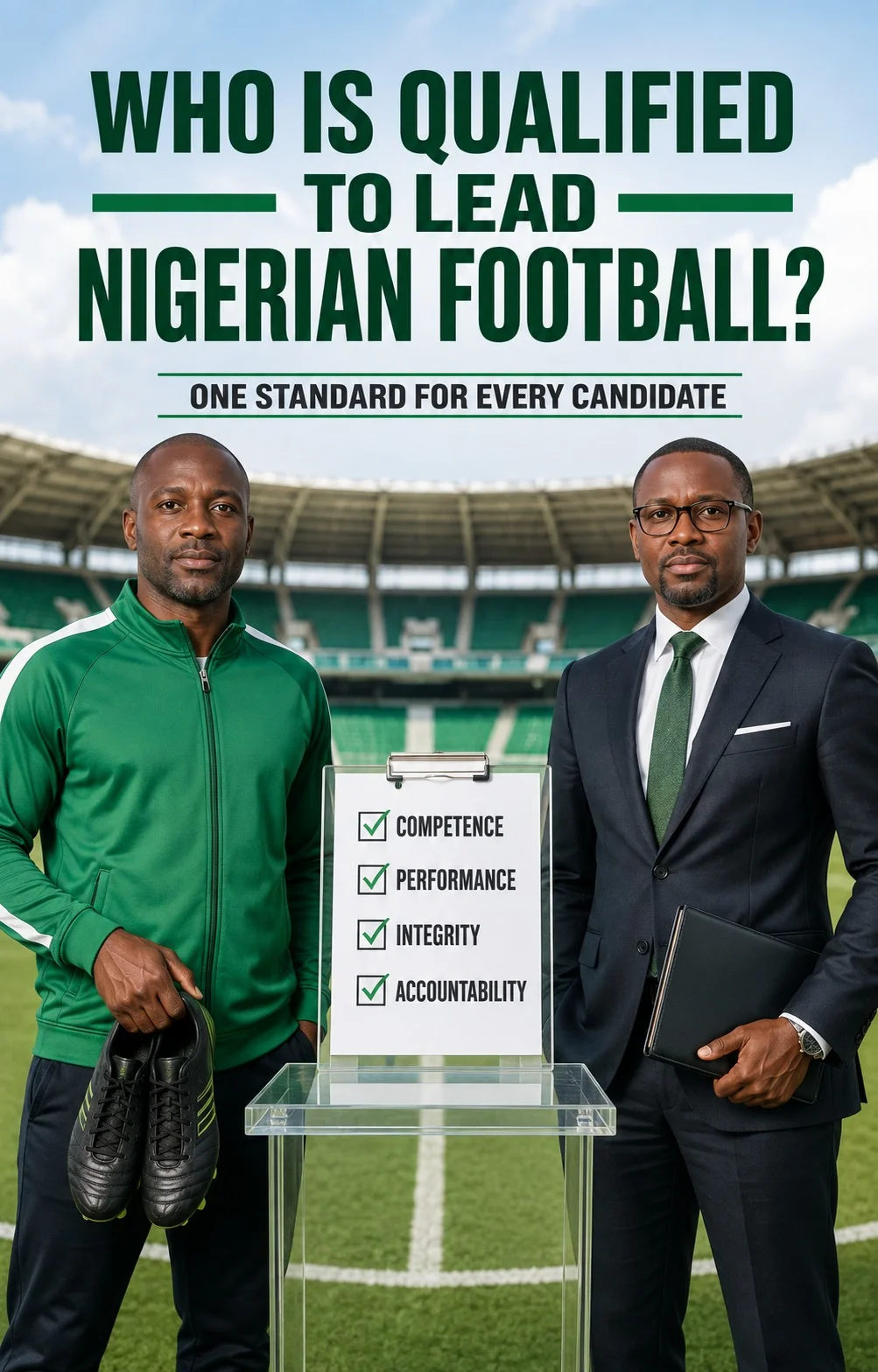
WHO IS QUALIFIED TO LEAD NIGERIAN FOOTBALL?
Whenever former footballers seek leadership roles in Nigerian football, one argument quickly emerges:
“Playing football does not qualify anyone to administer football.” –
That statement is correct. A successful playing career should not provide an automatic ticket to the presidency of the NFF or any other leadership position.
However, neither does being a businessman, politician, lawyer, journalist, or career football administrator automatically qualify anyone to lead.
Professional identity is not evidence of leadership competence.
Former players may understand dressing rooms, player welfare, international competition, and the consequences of administrative decisions. However, this experience must be supported by governance, financial management, strategic planning, and organisational leadership.
Non-players may possess strong business, legal or administrative experience. However, they must also demonstrate an understanding of football development, player welfare, safeguarding and the responsibilities of governing a national sport.
The standard must be the same for everyone.
Before any NFF election, candidates should be required to provide:
* verified qualifications and relevant experience
* evidence of organisations, finances and people successfully managed
* conflict-of-interest, integrity, and safeguarding declarations
* a public four-year manifesto containing measurable targets
* a commitment to annual performance reviews and public reporting
Candidates should explain how they will develop grassroots leagues, women’s football, coaching, refereeing, facilities, player welfare, commercial revenue, and transparent governance.
Leadership should not be awarded because someone once wore football boots. Neither should it be awarded because someone has spent years within football politics.
The question is not:
“Can a former footballer lead?”
The real questions are:
What has each candidate managed?
What measurable results have they achieved?
Can they manage public and football resources responsibly?
Do they possess the integrity to protect the institution?
What will they deliver within four years?
How will Nigerians measure their performance?
Former players and non-players should compete under one transparent leadership standard.
The qualification should be competence.
The evidence should be performance.
The foundation should be integrity.
The final test should be accountability.
Who, based on these standards, is qualified to lead Nigerian football?
By Monday Nas Ozoya
An excerpt from an article by Paul Lucky Okoku

🇳🇬 NIGERIA FOOTBALL 10-YEAR MASTERPLAN: WHERE IS THE EVIDENCE OF IMPLEMENTATION?
Nigeria launched the Football 10-Year Development Masterplan for 2022–2032 with a clear timetable:
* Planning: 2022–2023
* Initial implementation: 2023–2025
* Major evaluation: 2025
* Continued implementation: 2025–2027
We are now in 2026.
Nigeria is no longer at the policy-design stage. We are within the implementation, evaluation, and public accountability period.
The former NFF board, the relevant government sports institutions, state football associations and other responsible bodies should therefore provide evidence-based answers to the following questions:
1. Was the required 2025 evaluation completed?
2. Where is the item-by-item public implementation report?
3. Were the laws, statutes and regulations governing Nigerian football harmonised?
4. Was the proposed National Football Database Information System deployed?
5. How many functioning state and regional youth leagues were established?
6. How much of the proposed ₦12 billion annual requirement was approved and released?
7. How much reached grassroots football, domestic leagues and state football associations?
8. Was a national audit of public and private football facilities completed?
9. How many facilities were rehabilitated, where are they located, and are they functional?
10. What academy registration, licensing, inspection and grading system was introduced?
11. What measurable progress was achieved in school football and women’s football?
12. Was the proposed Sports Code of Governance completed, published and enforced?
13. Was the Athletes’ Welfare Fund established, funded and independently governed?
14. Which institution is responsible for publishing annual football-development data?
15. What corrective action followed missed targets or delayed programmes?
These questions are not an attack on individuals. They are legitimate questions about a publicly announced national development plan.
Accountability requires more than listing meetings, tournaments, training workshops and national-team results.
Credible evidence should include:
* published evaluation reports
* audited financial statements
* programme budgets and expenditure
* registered participant data
* completed league fixtures
* facility audit records
* coach and referee development figures
* academy compliance reports
* school and women’s football participation data
* safeguarding records
* measurable outcomes by state and year
If implementation has occurred, the evidence should be published and recognised.
If implementation has not occurred, Nigerians deserve to know:
What prevented delivery?
Who was responsible?
What happened to the allocated resources?
What corrective plan is now in place?
Changing NFF leaders without evaluating the Masterplan risks repeating the same cycle. A new administration should not begin with another policy document until the country has established what happened to the existing one.
The central question is simple:
What was promised, what was funded, what was delivered, and where can Nigerians independently verify the evidence?
Coaches, players, referees, administrators, state FAs, journalists, academics, supporters and grassroots organisations are invited to contribute constructively.
If you have verifiable evidence of implementation in your state, please share the programme, location, date and supporting record.
Let us assess Nigerian football through evidence, not announcements.

🇳🇬 STATE FAs ARE NOT APPENDAGES. THEY ARE THE ENGINE ROOM OF NIGERIAN FOOTBALL.
Nigeria cannot develop football from Abuja alone.
The NFF sets national direction. But football itself is made in states, LGAs, schools, communities, clubs, and academies. That makes the state FA the actual site of development, not a formality between it and the national team.
A state FA that exists mainly to attend congresses, run elections, and welcome national officials on tour is not functioning as a development institution. It is functioning as a ceremony.
So, it should be judged like any other institution: by what it can prove, not what it announces.
Every state FA should be able to answer, on demand:
📋 How many clubs, academies, players, coaches, and referees are registered?
🏘️ How many LGAs run structured football programmes, not just one showcase tournament?
⚽ Are there functioning leagues from under-10 to open age, year-round?
👧 How many girls and women are participating in organised football?
🎓 How many coaches and referees get continuous professional development, not a one-off course?
🏟️ Which facilities have been inspected and certified safe?
🛡️ Does every affiliated club and academy have a safeguarding officer and a reporting line?
💰How much funding came in, where did it go, and what did it produce?
📊 Where can the public actually see the development plan, the audited accounts, the annual report?
These are not hard questions. They are the minimum evidence any functioning administration should be able to produce.
State FAs exist to coordinate local football councils, regulate academies, maintain real player records, develop coaches and referees, run year-round competitions, enforce safeguarding, and connect grassroots talent to a national pathway, in partnership with schools, local government, universities, businesses, and health institutions.
Success is not the number of trophies presented at a closing ceremony. It is participation, player retention, qualified personnel, functioning leagues, safe facilities, financial transparency, and community impact that can be measured, not just announced.
Nigeria’s football pyramid cannot be stronger than its state-level foundation. Weak state FAs hand the NFF poorly prepared players, undertrained officials, fragmented data, and unstable competitions. Strong ones turn talent development into a system instead of a lucky accident.
Which means the reform conversation Nigeria keeps having, “who becomes the next NFF President,” is the wrong conversation to have alone. The one nobody’s asking is: who runs football in each of the 36 states, and what have they delivered?
State FAs are not ceremonial branches of the NFF. Not political platforms. Not election machinery.
They are football development institutions, and if we govern, fund, and hold them accountable, they become the engine room
Nigerian football has long lacked.
So, what has your state FA delivered in the last four years?
Name the programme. Name the location. Name the date. Show the evidence.
Let us assess performance through evidence, not announcements.

📊 NIGERIA'S SPORTS INDUSTRY: ₦2–4 TRILLION OPPORTUNITY, OR ₦2–4 TRILLION ASSUMPTION?
A new industry outlook says targeted investment could unlock ₦2 trillion to ₦4 trillion in Nigerian sport over the next decade. That is a genuinely exciting number.
So here is the question nobody is asking: what is it actually a number of?
The same report converts ₦2 trillion to roughly $4.4 billion in one place and ₦2-₦4 trillion to $1.4–2.8 billion in another. Two different exchange-rate assumptions, with no explanation of either. A projection you cannot reproduce is not a forecast. It is a guess wearing a suit.
To be clear, this is not a case against ambition. Nigerian sport genuinely needs to stop being a government-dependent recreational activity and start being a professionally governed industry: real jobs, real investment, real intellectual property. That shift is correct. What is missing is proof it is already happening at the scale being claimed.
What the report gets right:
✅ Success is not just medals; it is institutions, commercial viability, youth participation, investor confidence
✅ Governance is economic infrastructure — investors need audited accounts, enforceable contracts, and predictable regulation before they write a cheque
✅ Real opportunity exists in digital broadcasting, women’s sport, esports, sports tech, and facility development
What it cannot yet answer:
❓ How were contributors selected, and did any of them have a commercial stake in what they praised?
❓ Is the ₦2 trillion revenue, investment, or wider economic impact? Those are three different things wearing the same number.
❓ Where’s the baseline data, participation surveys, federation financials, athlete and coach registers, that any of this could be measured against?
Because here is the uncomfortable truth: more events, more sponsorship deals, and more media coverage are not automatically sports development. They are commercial activity.
Development is measured by whether participation grew, whether jobs were sustainable, whether local coaches became qualified, and whether facilities remained open to the community after the cameras left.
Commercialisation should finance development, not replace it, and not be mistaken for it.
And two things this outlook barely touches deserve full chapters of their own: gambling’s growing grip on sponsorship and fan behaviour, and safeguarding measured by real audits, not just the absence of scandal, which tells you nothing about whether reporting channels actually work.
Nigeria does not just need an optimistic market projection. It needs a transparent system that can answer:
Who invested? Where did the money go? What revenue was generated? How many jobs were created? Which communities and athletes benefited?
Until those questions have verifiable answers, the trillion-naira opportunity is an investment scenario rather than an established market fact.
What is your take: is Nigerian sport ready for this kind of investment case, or do we need the data first?
By: Monday Nas Ozoya
Our Process
We Find & Fund
We are in search of opportunities to help as many youth as possible. We approach and fund all those who are in need.
We Provide Care
Today’s youth need a helpful hand and the right guidance at every stage. Here’s where we take care of them like our own.
We Educate
We run small-scale schools for the underprivileged children and youth of daily wage workers for a better future.

The Goal
Our Mission
To identify the most vulnerable children affected by natural disasters or conflict whose lives and support systems are disrupted. We desire to create a meaning to life for these children by identifying their interest in football as we believe that football stimulates a positive and protective environment for children; subsequently improving their life skills, cognition, health, confidence, emotion and keeping them away from all form of negative coping activities that emanate from the consequences of a broken society. “Our goal is to ensure that every child and young individual receives the support they require, precisely when they require it, regardless of the nature of that support.”
The Outlook
Our Vission
To provide psycho-social support for children affected by crises through football. “Our dedicated team envisions a world where every young person facing challenges feels empowered to seek assistance, knowing there are individuals ready to support them in education, employment, and beyond. We aim to expand our presence into every region to ensure accessibility for all.”
WHAT WE DO
We Inspire, Develop & Support
Our mission is to inspire vulnerable children by instilling these powerful beliefs in them: ‘Believe in yourself. You are stronger than you know. Keep dreaming and never give up. Your future is bright. You matter.’ We are dedicated to nurturing their potential, providing hope, and helping them build a brighter future. We develop belief. We develop strength. We develop dreams. We develop resilience. We develop futures. We develop significance. Our mission is to empower vulnerable children through development, guiding them to believe in themselves, discover their inner strength, pursue their dreams, and forge resilient futures where they matter.
“We support belief. We support strength. We support dreams. We support resilience. We support bright futures. We support significance. Our mission is to uplift vulnerable children through unwavering support, nurturing their belief in themselves, bolstering their inner strength, fostering their dreams, and empowering them to embrace resilient, meaningful futures where they truly matter.”

Our Projects
At Ozoya Football Foundation, our projects are designed to promote youth football and coach development in Nigeria. Here are some of our key initiatives:
- Youth Football Tournaments: We organize youth football tournaments across Nigeria, providing a competitive platform for young players to showcase their skills.
- Grassroots Football Competitions: Our grassroots football competitions aim to identify and nurture young talent at the community level.
- Football Coaching and Referees Programs: We conduct football coaching and referees’ programs to develop the skills of local coaches and referees. To ensure they can provide high-quality training and refereeing to young athletes.
- Donations and Support: We donate football kits and equipment to underprivileged communities, helping them participate in our programs.
- Fundraising Initiatives: Our fundraising events support grassroots football projects, ensuring sustainability and growth.